Lamine Yamal, Selflessness, And The World Cup
For the true champion is the one who gives himself up for the rest.
Kylian Mbappe put it best.
"I would've exchanged my three goals for an ugly own goal and a 1-0 win," the French superstar said of the 2022 World Cup final in the aftermath of the game and his legacy performance in France's loss to Argentina.
Mbappe echoed those sentiments after the third-place game in 2026, stating how he would trade being the competition's top scorer for a spot in the final.
It's the nature of an athlete to want to win. Sacrificing personal achievements for team greatness is far from a groundbreaking sentiment, but it's rarer for a player to actually go out and take that role.
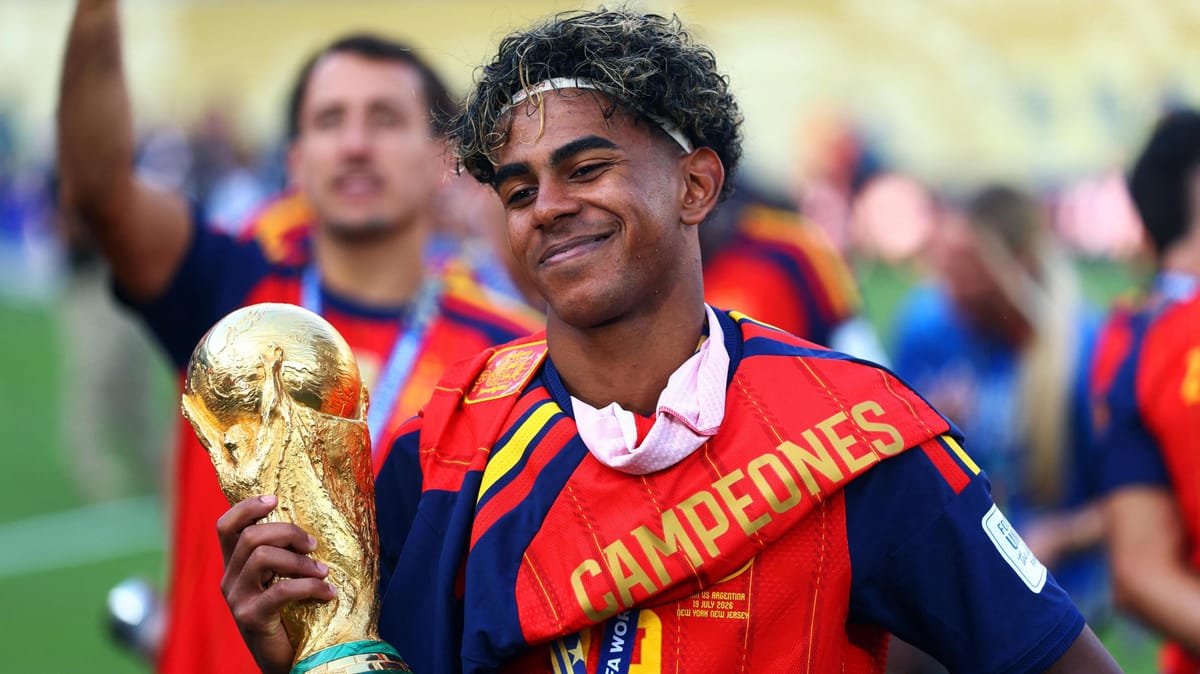
Enter Lamine Yamal and the Spanish national team.
The talk coming into the 2026 World Cup was how it would be Yamal's tournament, even if he was carrying a hamstring injury entering the competition.
This would be the first chance for the planet's next earth-shattering superstar to grab the biggest tournament on earth by the horns and announce himself to the world on the biggest stage.
After all, that's about all he's done so far in his young career. The Catalan phenom burst onto the scene as a 15-year-old and instantly became a key player for Barcelona, and at 16 (turning 17 during the tournament) was the main man for Spain's European championship side.
It was only natural to expect him to follow that beaten path into the World Cup at 18 (once again with a mid-competition birthday), now seen as arguably the world's best player.
As the entire tournament progressed, it felt like every pundit and fan was waiting on Lamine Yamal to have his moment.
The moment where he'd pick the ball up on the right wing, skip past a defender, and send a gorgeous curling effort into the top corner like he's done so many times before for club and country. The moment where he'd play an impossible trivela pass behind the opposition's entire defence for an impossible assist.
But, that's not happened, mostly because of the role Spanish manager Luis de la Fuente had Yamal playing.
With the slightly uncertain health condition of his star winger and so many other strengths to build towards, de la Fuente set Spain up in a way that less mirrored the dynamic offence the 2024 Euros team, and instead as more of a throwback to the country's true golden generation of 2008-2012.
If they don't have the ball, they can't hurt us.
This is Spanish footballing heritage.
It may be boring in practice, with a team set up to use possession and the ball at their feet to limit their opponent's touches, and slow and methodical buildup structures to ensure the team's rest defence was always in a good spot to snuff out and potential counterattacking threat.
But, there's no doubting its effectiveness. Spain suffocated every opponent they faced, with the defensive numbers telling the whole story in and of themselves.
Goals conceded? One in eight games, to Belgium's Charles De Ketelaere in the quarterfinal. Shots on target conceded? Ten all tournament. xG conceded? 2.31, with Portugal's 0.63 in the round of 16 the only to even break the 0.5 mark.
Defensively, no World Cup winner has ever been so perfectly stingy. Defending to this level is no doubt a team effort, from the repress from the front line, to the midfield's ability to both retain the ball and win it back, to the full-backs locking down opposing wingers, to the centre-backs dominating anything in the air, to goalkeeper Unai Simon's unreal ability to sweep.
It all went perfectly to plan, and it's ended with the second star now sitting atop the Spanish crest for eternity.
But, lost in all of this was the underwhelming statistical profile of Spain's main man in the attack. Yamal's one goal and zero assists in eight games really doesn't jump off the page, and if you told an average person ahead of the tournament this would be the case, they'd probably say it was a disappointment.
Yet, his ability to fit into the system, the Spanish Machine, is one of the biggest reasons the 19-year-old is now a World Cup champion, and it would be totally unfair to say the Barcelona man was a disappointment on the pitch.
The gravity the youngster has thanks to his ability on the ball causes opponents to play him differently, and de la Fuente understands this. The best illustration of this phenomenon is on Spain's second goal against France.
Yamal does not touch the ball in the buildup to this goal once. Yet, his presence is the only reason it goes in at all.
French left-back Lucas Digne is entirely focused on Spain's right winger, that part is known. If Yamal attempts to make a run in behind to get the ball as Fabian Ruiz and Porro play a little one-two on the inside, the play is dead as Digne will be right with him.
Instead, he uses himself as a decoy, taking himself out of the play for the benefit of his team. Yamal drifts slowly but purposely away from goal and towards the touch line, dragging Digne with him.
Because of this, a gap is opened up in the French defence. Porro plays the ball into Dani Olmo's feet and immedaitely attacks this gap, receiving the ball back in tons of space in the box, and fires the insurance goal past Mike Maignan.
If Yamal had stood there wanting the ball to feet, that goal doesn't happen. But, the selflessness and ability to play into the system and do the right thing for the team is the reason why Spain are practically unbeatable at these major tournaments.
Every piece, every movement is a cog in the impenetrable machine. No player is bigger than the team, yet every player makes the team shine brightest.
How Spain Won The Trophy
Now, onto the final itself.
Spain entered the game without any true surprises in their approach to defeat the defending champions, with the two key ethos seeming to be keeping Lionel Messi's touch count as low as possible, and to avoid the game turning into a stretched mess.
They unequivocally succeeded on those two fronts, with Messi really not getting on the ball and impacting the game much at all, since Spain pretty much always had possession, and the same slow, methodical buildup patterns we've seen all tournament ensured the game was played at their pace.
But, through 90 minutes, nothing much happened. Argentina were happy sitting back, fouling and just keeping the Spanish outside the 18-yard box. Yamal arguably had his best performance of the tournament on the ball, creating havoc and danger on the dribble, and really being the only one daring enough to consistently take players on.
But, there was never a moment where the game opened up at the right time.
As the match wore on, the Argentinians battered and bruised, losing both starting centre-backs due to injury, the game tilted more and more in the direction of the Spanish.
It was de la Fuente's substitutions that picked the lock, in the end. Ferran Torres and Mikel Merino gave the Spanish a more focal presence in the box while Pedri's invention with the ball opened up more lanes to attack.
But, it was Nico Williams who truly changed the game. After a frustrating World Cup campaign dealing with some small injuries and never being able to really go from the start and replicate the heights he showed at Euro 2024, the Bilbao winger saved his best play for the very biggest occasion.
Williams used every bit of his toolkit to his advantage against the Argentinian back line.
While his north-south pace and ability to drive at defenders on the ball gave a different look to Spain's left side, while his willingness to always crash the back post off the ball was truly what started to make Spain so dangerous.
And, as Europe's "The Final Countdown" blared from the speakers at the break in extra time, one last team huddle from the Spanish led to one of the greatest moments in the country's footballing history.
Lamine Yamal collected the ball on the right wing. He played a little ball backwards to Porro, whose cross to the back post was met by who else but Williams, pushing and jumping to win the ball.
Go for goal? Not from that angle. Instead, he picked out Torres arriving behind him 10 yards from goal, knocked it back into the striker's path, and Torres made no mistake rifling it home past the scrambled Argentina defence.
Already up a man thanks to Enzo Fernandez's two yellows near the end of regular time, and now up a goal, Spain held on for the rest of extra time to become World Cup champions for a second time.
The midfield maestro Rodri picked up the golden ball as player of the tournament thanks to his consistent excellence in the middle of the park.
Mbappe's 10 goals won his second straight golden boot, and leaves him the top goalscorer in World Cup history at the age of 27, with likely at least two more tournaments left to play in his career.
Spain's centre-back Pau Cubarsi picked up the top young player award thanks to his combination of front-foot defending and ball-playing excellence.
Entering the tournament, it was easy to see Yamal as the potential favourite to win any, if not all three of those awards.
But instead, the he sacrificed his potential individual accolades to be a key cog in the machine, rather than the driver of the boat.
That will forever be the legacy of Lamine Yamal, the teenage prodigy whose selflessness was the key factor in winning a World Cup.