


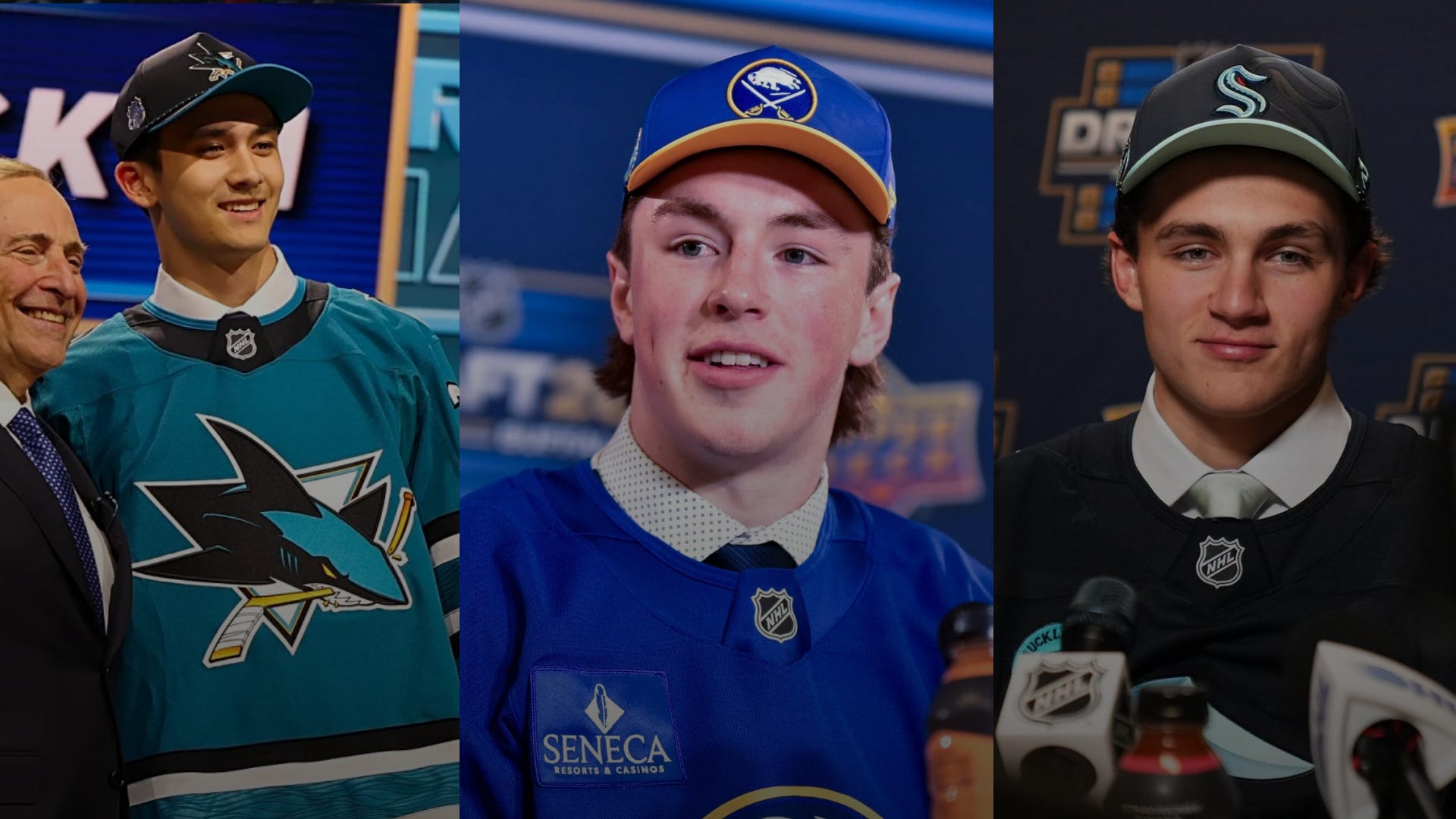
Every year, hockey fanatics gather around at their TV sets, on Discord calls, and at in-person watch parties for one of the NHL’s premier events: The NHL Draft.
For those with skin in the game, the intensity is the closest it gets outside of the NHL playoffs. Will your team draft their next shining star, a franchise staple for many years to come, or a flame-out whose name is only remembered in hockey databases and in obscure trivia?
With a projected weaker class this year, the 2026 NHL Draft has brought more surprises than usual through its first 32 picks.
Riser: Daxon Rudolph (BUF #4)
Facing tumultuous, impending RFA negotiations with defenseman Bo Byram, whose ask reportedly is around the $12 million range per season, the Buffalo Sabres were able to flip the 25-year-old left-shot defenseman and physical forward Jordan Greenway to the Chicago Blackhawks ahead of the draft for a tall right-shot stop-gap Louis Crevier, a second-round pick, and the fourth overall pick.
For Sabres fans, this deal, along with the following acquisition of Olen Zellweger for Anaheim, made it feel like Christmas came early. However, little did they know, the festive spirit would lend itself to who they took at fourth overall.
There were plenty of rumours circulating about the pick, with some suggesting it was part of trades to acquire Connor Hellebuyck of the Winnipeg Jets, Matthew Knies from the Toronto Maple Leafs, or even Vincent Trocheck of the New York Rangers. Should they have kept the pick, the growing sentiment was that they were set on Caleb Malhotra, or perhaps Viggo Bjorck.
With the pick kept and Malhotra going to play under his father in Vancouver at third overall, few expected the Sabres to take a defenseman, Daxon Rudolph, no less.
Despite the instant shock, the pick makes a lot of sense. Rudolph is an offense-leaning, two-way defenseman with tremendous upside. More importantly, he’s also a right-shot, an area in which Buffalo desperately needs help. Where this might prove to be an issue is that Rudolph remains quite raw physically, despite his 6-foot-2, 200-plus-pound frame, frequently getting bumped off pucks by diminutive players.
Was it the best pick at the spot at the time? Not necessarily with fellow righty Chase Reid still on the board. However, Rudolph may very well become comparable in terms of impact, if not greater, than what Bo Byram did for them—and that should make it enough of a win.


Faller: Chase Reid (SEA #7)
Chase Reid’s stock has spent the better parts of the past two years strapped to a jet pack. From a USHL cut and NTDP afterthought, he worked his way through the NAHL before joining the Sault Ste. Marie Greyhounds, where he established himself as a dynamic, impactful player in his D-1 campaign. This season was no different, rising up from first-round consideration to the Top-10, before establishing himself as what seemed like a surefire Top-5 talent.
When Toronto was awarded the first overall pick in May, Reid’s name began to emerge as a challenger to Gavin McKenna and Ivar Stenberg. He seemed linked to the Sharks at two, a possibility for the Canucks at three, the Sabres have a hole on their right side, and by God, if he was available at five, the Rangers seemed stupid not to take him. But alas, Reid kept falling.
The Sharks ended up deciding that going for Ivar Stenberg at 2 while risking the availability of right-shot defenseman Keaton Verhoeff at 9 was the better move for their future. Vancouver went with their centerman. Buffalo went for a righty but preferred Rudolph. As for the Rangers and Flames, they felt confident enough in Adam Fox and Zayne Parekh as their cornerstones on the right, instead drafting their left-handed foils, Alberts Smits and Carson Carels, respectively.
Reid ended up a victim of circumstance, but also a fallen angel for the Kraken, who should look to re-ignite their defense corps as soon as the 2027-28 season. There’s a reasonable top pair upside with Reid, who projects as a high-flying, mobile two-way defenseman, and with Brandon Montour’s slide over the past couple of seasons, he should have the opportunity to get there, too.

Faller: Ethan Belchetz (UTAH #17)
Ethan Belchetz is the exact mould of a player that makes NHL general managers imitate a Great Dane on a hot summer’s day.
A cerebral, six-foot-five power forward with great contact skills and good tools to boot. Even when tending to take on more of a complementary role than an involved play-driving one, he invokes the likes of Porter Martone and Juraj Slafkovsky.
Sure, his production was a bit muted for a higher-end projected pick, averaging around the No. 10 mark, but the tools and archetype screamed, he’s gonna go high if a team really loves him.
Turns out, one team did love him and traded up to select him: the Utah Mammoth, who continue to live up to their name with the size of their draft picks. However, it was not until the Windsor Spitfire fell all the way to 16th.
There’s a wide variance with Belchetz’s potential. The best case is building off of flashes of a driving game into an impactful second liner. However, Belchetz seems fit to work in a down-the-lineup role as a net-front player, physical forward.
Not necessarily a steal per se, but a bit surprising that he went this late, given the historical fixation on players of his type. Perhaps teams are starting to grow more wary of bigs, having previously been burned by Flyers’ 12th overall pick Jack Nesbitt and then-Arizona Coyotes 11th overall pick Conor Geekie, now a system player within the Tampa Bay Lightning.

Faller: Ryan Lin (SJ #21)
Ryan Lin’s stock may have slipped from its early-season apex, which saw him enter Top-10 and even some Top-5 conversations, but it seemed like a long shot for the Vancouver Giants’ blueliner to fall into the twenties.
While Lin shored up his defensive play, coupling his strong offensive base with a cerebral shutdown game, it may have led scouts to question his projection. Do teams value an offensive-first undersized defenseman more than a defense-first one?
Furthermore, where does he fit in the grand scheme of things? Does he have the dynamism to command a top pair or power play? Will his stature pose problems for a penalty killing projection?
These questions ultimately led to Lin’s, likely unjust, downfall on draft day, but also to the Sharks’ easiest win of the night—who could benefit from his mobility-heavy, steady two-way play in the short-to-medium future after what could be a rather short cup of tea in Denver.

Faller: Adam Novotny (VAN #24)
It boggles the mind that Adam Novotny fell to 24th.
He’s an easy projection to the NHL with a high-effort, forechecking game with good stick and physicality, all the while acting as a dual-threat scorer, driving to the slot and ripping or winding up and finishing one-timers.
While Novotny has had his fair share of lovers this season, he’s also drawn the ire of some scouts, who were turned away by what was called a lack of physical runway, supposed skating concerns, and an early 2007-birthday.
However, a case of the yips in the playoffs seemed to have sealed the fate of the otherwise surefire Top-15 prospect, falling into the back-half of the first.
Vancouver will surely reap from the mistakes of many teams before them. Make no mistake, should he hit his potential, the Czech forward could very well replace the offense from Brock Boeser in just a few short years.

Riser: Jonas Lagerberg Hoen (OTT #25)
Every year, there’s usually at least one player who gets taken in the first round that leaves most fans asking: “Who?”
This year, the Senators even managed to fool some executives, selecting Jonas Lagerberg Hoen with the 25th overall pick, who suited up in just 11 games due to a season-ending knee injury. Since making his U20 Nationell debut in 2024-25, Lagerberg Hoen has netted 46 points in 47 regular games, of which an astounding 36 have been goals.
While the Swedish winger went under the radar, make no mistake, this is a high-upside bet.
His game is all about getting pucks to the middle, either crawling up the slot, plowing his way through, or skating around defenders, or finding seams to players crashing or around the net. The hope with this pick is that he will help recreate Brady Tkachuk’s finishing in the aggregate, alongside prospect Kasper Haltunnen, acquired earlier from San Jose in the William Eklund trade.
There are a few questions about his NHL projection. Has his knee injury impacted his mobility, and is he as one-dimensional as his stats might suggest?
On the bright side, Lagerberg Hoen was a full participant at the NHL combine and is set to attend the team’s development camp. As for the rest of his game, the playmaking has come in flashes, and there’s some semblance of a projectible forechecking game, but both are in dire need of growth to hit an NHL projection. A potential up-to-middle of the lineup scoring forward at his best, or one of those guys who can light up the juniors and Europe, but not quite stick in the NHL at his worst.

What’s left
Ultimately, while you’d want to hit a home run with every first-rounder as these are the players you build around, drafts are often won or lost on Day 2, and there are plenty of tantalizing players left on the board.
Undersized left-shot Xavier Villeneuve remains a possible top-pair bet, but has fallen due to a lack of size, stagnating production and a hip injury he battled throughout the season.
Mathis Preston was once seen as a shoo-in for the Top-10 early season, courtesy of his high-octane playstyle, but has slid out of the first round as he doesn’t let the play develop around him.
Yegor Shilov should have warranted an easy first-round selection, with crafty playmaking and strong two-way details, but his lack of stamina and inconsistent engagement have scared off teams.
NHL teams continue to prove they are willing to stray from consensus if a player matches organizational fit, fits preconceived biases such as height, or is deemed a higher-upside bet.
Every team goes into the draft thinking they are going to pick the smartest, but each team has a different definition of what that means. For some, it’s sticking to the consensus and taking the guy who’s falling. For others, it’s deviating from the mean and banking on upside reaches.
Ultimately, the true winners and losers of the draft won’t be accurately identified until many years down the line, after confounding variables, including injuries, opportunities, and playstyle changes, will ultimately muddy those discussions.
But for now, let’s huff a little hopium and relish in the best off-ice spectacle hockey has to offer.