The Disastrous 2024 NBA Draft.

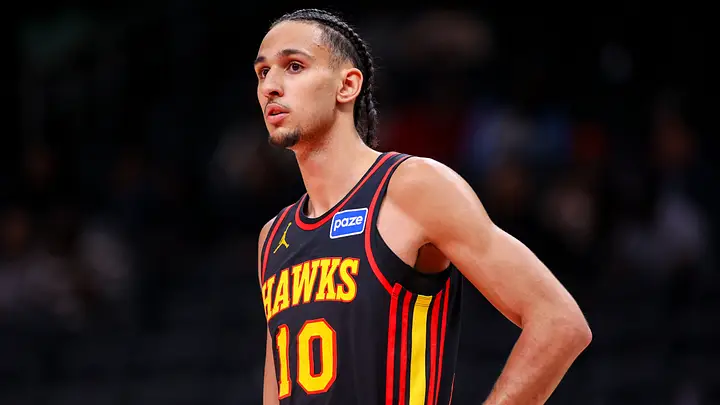
On May 12th, 2024, the Atlanta Hawks won the NBA Draft Lottery, securing the 1st overall pick. Most years, this would be a franchise-altering card flip, and on June 26th, Adam Silver would step on stage and announce that the Atlanta Hawks had selected French forward Zaccharie Risacher.
Fast forward 2 years to July 19th, 2026, and Shams Charania would announce that the Atlanta Hawks had traded Zaccharie Risacher to the Dallas Mavericks in a 3-team trade, in which they acquired Ryan Nembhard from Dallas, an undrafted player out of the 2025 draft; that was that. The Risacher era was over as quickly as it started; the 1st overall pick was dumped for an undrafted rookie just 2 years after being selected.
Zaccharie Risacher the concept is a great one, a 3&D monster at the small forward position. Zaccharie Risacher the player is less than ideal, losing his rotation spot in his sophomore season to the likes of Mohamed Gueye and Gabe Vincent; it was simply a season to forget for Risacher, as it ended with the Hawks being blown out by 50 to the eventual champion Knicks, a game in which Risacher still did not get to play until the end of the 3rd quarter. Let's take a look at his rookie season, where he came 2nd in Rookie of the Year voting. The numbers on paper were alright, yet the advanced metrics once again showed a player who the Hawks simply would’ve been better off benching; the potential is all there, and this is about as buy-low as it gets.
There was just one main issue with the Risacher pick: he was never the consensus #1 prospect. Alexandre Sarr, selected 2nd overall, likely would’ve gone #1 to Atlanta had he not openly refused, preferring to go to Washington where they would allow him to play center full-time, as opposed to playing as a power forward.
So let’s take a look at Alexandre Sarr; to start his career, he’s been limited to 115 games due to injuries and has been underwhelming. Potential is sky-high for a guy with his build and defensive prowess; it’s extremely hard to imagine him ever becoming a superstar, but an impact fringe all-star and 3rd best player on a contender seems like an attainable goal. The issue with him today could be boiled down to the lack of talent surrounding him; however, the team is marginally better with him off the court, a common theme amongst the players we’ll talk about today.
The third pick in this draft was Reed Sheppard, a guard out of Kentucky who got almost no burn in his rookie season and was thrust into a significant role as a result of the Fred VanVleet injury. In his sophomore season Reed was a 6th Man Of The Year contender, yet the Houston Rockets were statistically a better team with him off the court. The playoffs are where this fact was magnified, as Reed was extremely inefficient, shooting 31% from the field and 29% from 3, with his playmaking keeping the team afloat offensively, all while being hunted on defence every second he stepped on the court.
Selected fourth overall out of UConn was Stephon Castle, a shifty combo guard who won Rookie of the Year out of this class, he was a major contributor in a finals appearance in his sophomore season and will likely be an All-Star at some point in the near future. Nevertheless, he is another player whose team had been statistically better with him off the court; this could be due to the guard depth of San Antonio, but it also could be the fact that he is a turnover-prone guard with lapses in offensive efficiency.
The fifth pick in this draft was Ron Holland out of the G-League Ignite, a defence-first forward with next to no offensive skills, averaging under 20 minutes per game in his sophomore season while also falling out of the rotation entirely when the postseason rolled around. The book on Ron Holland is to leave him open and try to get the ball in his hands. The Pistons are a significantly better offensive team with him off the court but also worse defensively, yet another guy where the total on/off numbers favour the off.
Now, we can rattle off the remainder of the lottery in this draft and show that the disaster does not stop in the top 5.
Pick #6: Tidjane Salaün, a G League-level talent with 0 redeemable skills, would be shocked to see him reach his second contract.
Pick #7: Donovan Clingan, a top 3 player in this class with elite defence, could easily give you 15 and 10.
Pick #8: Rob Dillingham, the second player in the top 10 to be traded, is a small guard whose inefficiencies and turnover numbers are eye-popping.
Pick #9: Zach Edey, when on the court, his impact is noticeable; he is one of the best players in this draft on a per-minute basis, but he just cannot stay on the court.
Pick #10: Cody Williams, brother of Jalen. It's clear that one of the brothers took all the basketball talent for himself; he's simply not an NBA-calibre player.
Pick #11: Matas Buzelis, coming into the 2024 season projected as the #1 player. Matas has shown flashes of being an all-star-calibre player; he just needs to put it all together.
Pick #12: Nikola Topić, the hardest player to grade in this class, as he missed his entire rookie season with a torn ACL and missed 75% of his sophomore season recovering from testicular cancer.
Pick #13: Devin Carter, the third player named so far to not be on the team that drafted them, drafted to be an NBA-ready player out the gate, has spent a majority of his career in the G-League.
Pick #14: Bub Carrington, an inefficient turnover machine with extremely high highs and extremely low lows, has yet to miss a game in his NBA career!
Pick #15: Kel’el Ware, a large piece in the Giannis return this summer, is an efficient box-out beast with great underlying analytics.
Outside of the lottery there were some gems and some busts. Starting with the gems, the Philadelphia 76ers drafted Jared McCain with pick #16, a favourite to win the Rookie of the Year up until a torn meniscus took him out just 23 games into his career; his second season got off to a slow start as well due to a torn tendon in his thumb. When he returned, the 76ers' overabundance of guard play and contender status made it difficult for him to crack the rotation amongst his early-season struggles. The 76ers then traded him to the Oklahoma City Thunder, where he suffered inconsistencies but is a clear shooting threat next to Shai and should be a 6th Man of the Year contender this season. The Washington Wizards used their 3rd pick in this draft on Kyshawn George; the Swiss-Canadian forward was an important piece of the Wizards' rotation this season, showing flashes of good defence and scoring ability. He should be a staple in that lineup for years to come. The second round held two of the biggest gems in this class, as the OKC Thunder and Memphis Grizzlies selected Ajay Mitchell and Jaylen Wells, 38th and 39th, respectively. Ajay Mitchell was a 6th Man of the Year contender up until an abdomen injury took him out for 20 games; his scoring ability mixed with the elite team around him makes him an incredible option off the bench, and he should be competing with now-teammate Jared McCain for 6th Man of the Year again this season. Jaylen Wells came out of the gate extremely hot and has never really cooled down; a top 3 rookie in his class, he has been a legitimate high-level impact player in all 148 games of his career, including being a starter in 143 of them. Now, there were some busts outside the lottery we didn’t speak of but must get into, starting with the 17th selection to the Los Angeles Lakers, Dalton Knecht. Knecht showed many flashes early of being an elite 3-level scoring wing, competing with McCain for Rookie of the Year early; sadly, those flashes were just that, a flash. Knecht has largely struggled to get a rotational role on the Lakers since the second half of his rookie season and is looking like a prime trade candidate with the Lakers having 16 guaranteed contracts on the books. Another bust that must be mentioned is DaRon Holmes, selected 22nd overall by Denver. Holmes missed his entire rookie season due to a torn Achilles. Holmes came into his second season healthy but largely lost any opportunity at a backup center role due to the acquisition of Jonas Valanciunas. In his limited minutes, Holmes was a negative player but filled the holes well; it’ll be interesting to see what a make-or-break third season holds for him. The final bust worth talking about is the very next selection in the draft; with pick #23, Milwaukee selected AJ Johnson. A project coming out of the NBL, Johnson barely played whatsoever in his draft year for the Illawarra Hawks and came into his rookie season as a mostly unknown talent; just 6 months after being drafted, AJ Johnson was sent to the Washington Wizards in the Khris Middleton and Kyle Kuzma swap. This, however, would not be the last time he was traded, as just 1 year later Johnson was shipped to Dallas alongside Khris Middleton once again in the Anthony Davis trade. Just 5 months later the Dallas Mavericks would ship AJ Johnson to the Memphis Grizzlies in a 6-team trade that included Khris Middleton heading back to Washington, meaning that in his 2-year NBA career AJ Johnson is now on his fourth team, having been traded in 3 separate Khris Middleton trades.
Now that we’ve gone through the entire draft lottery, we can do an official redraft of the 2024 draft, showing just how many top players in this class came from outside the lottery.
#1: Stephon Castle (up from #4)
#2: Donovan Clingan (up from #9)
#3: Alexandre Sarr (down from #2)
#4: Matas Buzelis (up from #11)
#5: Reed Sheppard (down from #3)
#6: Kyshawn George (up from #23)
#7: Kel’el Ware (up from #15)
#8: Ajay Mitchell (up from #38)
#9 Jaylen Wells (up from #39)
#10 Jared McCain (up from #16)
#11: Zach Edey (down from #9)
#12: Jaylon Tyson (up from #20)
#13: Ron Holland (down from #5)
#14: Zaccarie Risacher (down from #1)
#15: Cam Spencer (up from #53)